

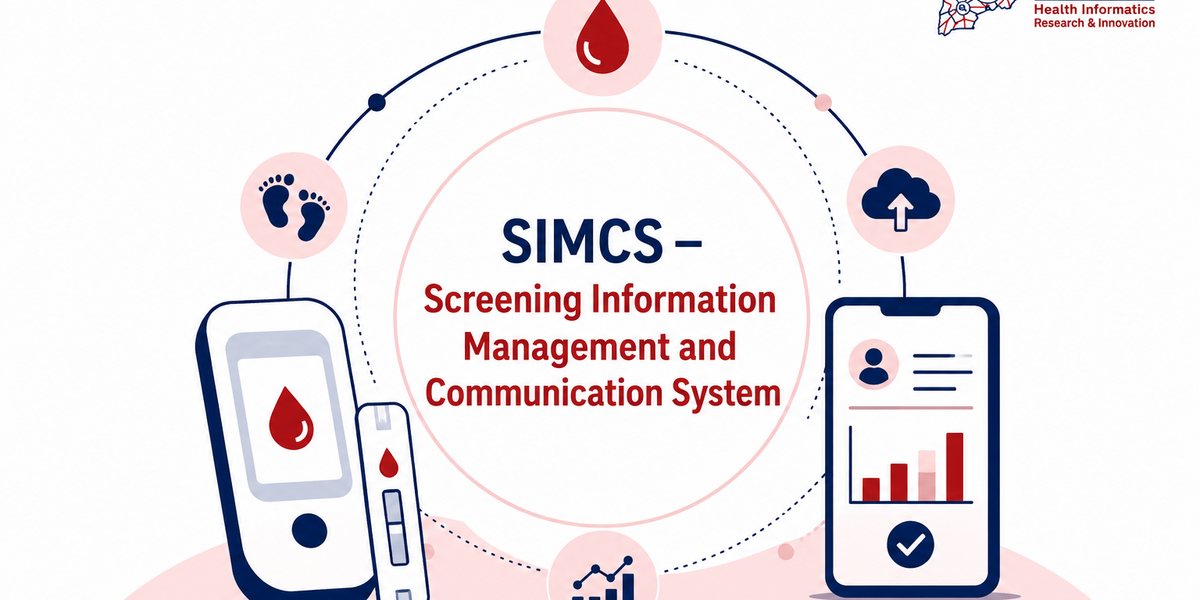
SIMCS designs and evaluates a locally sustainable Screening Information Management and Communication System for point-of-care infant sickle cell disease (SCD) screening, with the goal of enabling population-wide screening access in Uganda and across sub-Saharan Africa.
Reaching every newborn
Early detection saves lives — but only where screening data can be captured, managed and acted on.

The challenge
Sickle cell disease is a major cause of childhood illness and death in the region, yet low-resource settings often lack the systems to support screening at scale.
- SCD is a leading cause of childhood death in the region
- Early screening substantially improves survival
- Few systems exist to manage screening data and results

Our approach
Build an information management and communication system tailored to point-of-care infant screening.
- Designed for point-of-care infant screening
- Locally sustainable and nationally scalable
- Evaluated in the Ugandan context
Early detection through newborn and infant screening can substantially improve survival from sickle cell disease.
From design to scale
01
Design the system
Build a screening information and communication system fit for point-of-care use.
02
Deploy at point of care
Put the system to work where infants are screened.
03
Evaluate performance
Assess how well it supports screening in the Ugandan context.
04
Extend access
Support wider, population-level screening across similar settings.
Collaborators
Uganda Ministry of Health.