

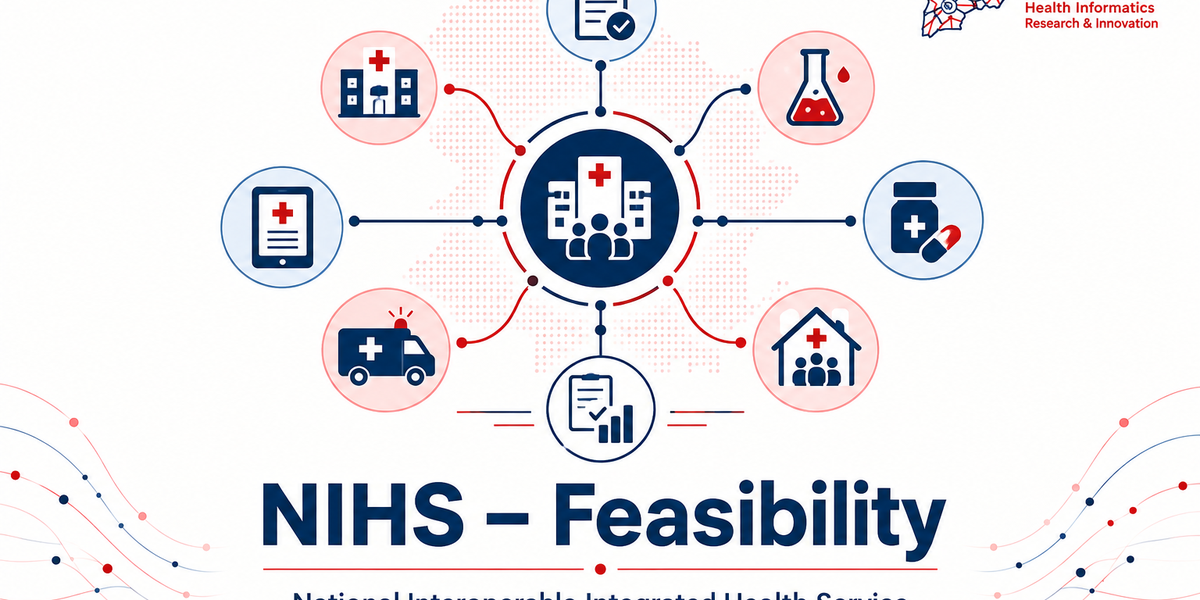
NIHS - Feasibility was a study assessing whether Uganda was ready to implement the National Interoperable Integrated Health Service (NIHS), a national electronic health data sharing platform, and what it would take to build the supporting data science capacity.
Is Uganda ready for a national platform?
Before committing to a national platform, decision-makers needed evidence of readiness, barriers and cost.

The challenge
Uganda had invested in digital health systems, but the readiness and cost of a national platform were unknown.
- Investment needed evidence of readiness
- Barriers, facilitators and costs were unclear

Our approach
A mixed-methods feasibility study mapping readiness and modelling cost.
- Readiness mapped to established adoption theories
- Cost-benefit analysis of implementation and maintenance
Findings guided Uganda's eHealth implementation strategy, with a focus on areas such as malaria and HIV management.
How the study was carried out
01
Provider questionnaires
Electronic surveys distributed to thousands of health service providers.
02
Facility interviews
Interviews at a sample of health facilities.
03
Literature review
Review of existing evidence on platform adoption.
04
Stakeholder focus groups
Group discussions to surface barriers and facilitators.
05
Cost-benefit analysis
Modelling of implementation and maintenance costs.
Outputs
Collaborators
University of Cambridge; Uganda Ministry of Health.