
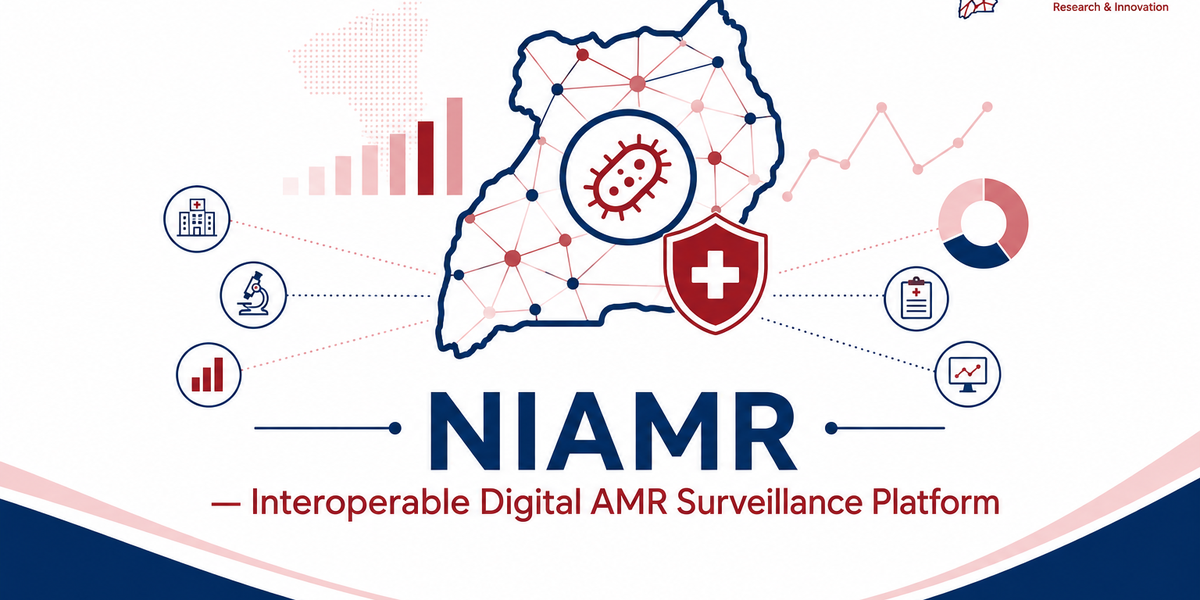
NIAMR develops and evaluates a national, interoperable digital platform for antimicrobial-resistance (AMR) data capture, processing and sharing in Uganda — bringing together AMR data from existing systems to support timely detection, monitoring and evidence-based decisions, with a One Health scope for scaling. A three-year (Feb 2026 – Jan 2029), NIHR-funded project led by Makerere University.
The challenge, the gap, and our response
Global and national AMR action plans identify surveillance — the systematic collection and use of AMR and antimicrobial-use data — as a core intervention. But that data must first be available and usable.

The challenge
Despite investment in microbiology laboratory capacity, AMR data in Uganda and many LMICs remains fragmented, incomplete and underutilised for decision-making.
- Fragmented, incomplete AMR data, underused for decisions
- Disjointed data systems that do not interoperate
- Shortages of skilled personnel at facility and national levels
- Limited clarity on national AMR data needs

Our solution
A national, interoperable platform (NIAMR) that integrates AMR data from Uganda's existing capture systems for timely detection, monitoring and evidence-based decision-making — built to scale across One Health sectors.
- Interoperable, integrated national AMR data platform
- Timely detection, monitoring and evidence-based decisions
- Scalable to animal health, water, wildlife and environment
- Delivered in five sequential phases (Feb 2026 – Jan 2029)
Collaborators
Uganda Ministry of Health; National Health Laboratories and Diagnostics Services (NHLDS); Baylor College of Medicine Children's Foundation – Uganda; Mbarara University of Science and Technology (MUST).