
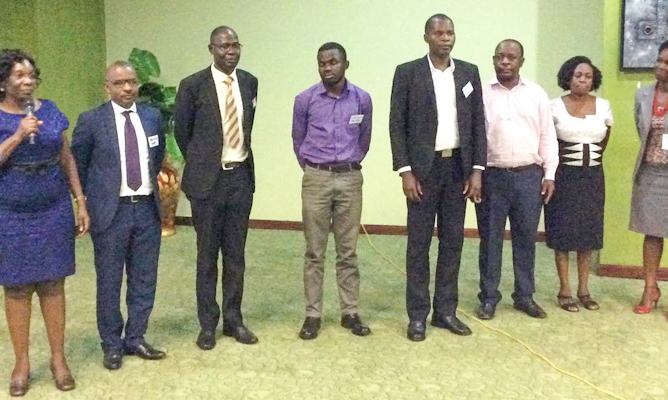
On 3 May 2018 at the Imperial Royale Hotel in Kampala, the Ministry of Health (MoH) — with support from the World Health Organization (WHO) and United Nations Children's Fund (UNICEF) — convened a donor conference to disseminate the eHealth Policy, Strategy and Implementation Plan, present the Enterprise Architecture Concept & Health Information Exchange and Resource Mobilization Strategy, and harmonise the eHealth implementation work plan for sustainability.
Stakeholders had previously noted that many donor-funded eHealth services stop at the pilot stage — where ICT is introduced to demonstrate how innovation can support health, but the projects lack local ownership, support, and funding. The conference thus provided an opportunity for stakeholders to address this and create sustainability and local ownership.
It is at this conference that the Health Informatics Research Group (MakHIRG) was officially launched. The Health Informatics Research Group is an interdisciplinary community of researchers from the School of Medicine, School of Computing and Information Technology, and School of Public Health. MakHIRG acts as a "catalyst for an actualised healthy society where health information solutions connect to more than 40 million people in Uganda and beyond" through conducting cutting-edge health informatics research. The group supports the implementation of the Uganda eHealth Policy and Strategy through undertaking research and development — providing the research arm for the MoH. Dr Josephine Nabukenya chairs MakHIRG and also sits on the eHealth Technical Working Group for Uganda and the Digital Health and Interoperability Working Group for the Health Data Collaborative. She has supported the development of the Health Informatics Graduate programmes (Masters and PhD) within East Africa.
The implementation of the eHealth policy and strategy will accelerate the ongoing reforms and sustain the gains witnessed in the health sector since 2015 — when the sector started the implementation of Health Sector Development Plan (HSDP). The policy and strategy will address some of the key challenges experienced during HSDP, including a shortage of qualified healthcare professionals at all levels of the health system; epidemics such as HIV/AIDS, Tuberculosis, and malaria; and limited access to health facilities and health professionals due to poor infrastructure, inefficiencies of the healthcare system, poverty, and lack of information.
The Permanent Secretary at Uganda's Ministry of Health, Dr Diana Atwine, re-echoed the stakeholders' concerns on funding and local ownership: "The pilots often stall when the development partner funding ends. The projects also fail due to lack of sustainability in terms of the supporting infrastructure such as affordable and reliable power and Internet connectivity." She further commended the work done by MakHIRG in research and guiding the implementation of the eHealth agenda in Uganda — especially in harmonising the current national health information and knowledge resources, which are in most cases fragmented, not interoperable, and largely funded by donors.
Mr Moses Bagyendera, the National Professional Officer in charge of Public Health Informatics at the WHO Country office, gave an overview of the formulation exercise of the policy. He also shared the costed implementation plan and the phased-out approach to implementation, urging members to embrace ICT in the health sector. The participants who attended the conference were from Academia, CDC Uganda and Atlanta, Civil Society Organisations, Ministry of Health, USAID, UBTC, the private sector, implementing partners, WHO and UNICEF.